

Green Attractions
Explore DTU Science Park
The Green Attractions
Explore the green attractions
A landscape designed for innovation and biodiversity
DTU Science Park is more than laboratories, offices, and facilities. It is a vibrant environment where nature, technology, and science are allowed to unfold side by side. Inspired by Arne Jacobsen’s vision for open research landscapes, DTU Science Park is designed as a place where ideas can grow.
That’s why you’ll also find a wide range of green attractions, from a 45-meter-long insect hotel to dedicated walk-and-talk paths and a magnolia garden created for relaxation and reflection. Here, we make space not only for world-class deep tech companies but also for wildflowers, native tree species, and wildlife, contributing to both ecosystems and human well-being.
We are also part of the Danish “Vild med Vilje” (Wild by Design) initiative and collaborate with the Danish Society for Nature Conservation. This means we prioritize biodiversity and let nature thrive where possible, even if it means the grass isn’t always perfectly trimmed. At the same time, we actively support efforts such as birdhouses, insect habitats, and insect-friendly plantings.
The green areas at DTU Science Park are designed for people, but with consideration for nature.

The Danish Forest
A living window into our green history
Long before the area became known as DTU Science Park, a close and valuable collaboration was established with our neighbor, the Arboretum in Hørsholm Municipality.
The arboretum serves as a living library of trees and shrubs from around the world, contributing to research, conservation, and contributing to research, conservation, and biodiversity awareness. This collaboration helps shape the unique character and natural richness that define the area.
The Danish Forest is a tangible example of this philosophy. Here, native Danish tree species have been planted, those that once grew in the landscape before the introduction of non-native species. Among them are birch, Scots pine, hazel, linden, and oak.
You might wonder why beech is not included. Although many consider it Denmark’s national tree, it is actually a relatively late arrival. From a botanical perspective, beech trees didn’t establish themselves until around 3,500 years ago, making them younger than several of the species growing here today.


The Insect Hotel
A home for DTU Science Park’s smallest residents
The large insect hotel in the southwestern part of DTU Science Park is built from trunks, roots, and branches of trees that once grew in the park. Whenever a tree has to be felled, we always plant a new one elsewhere in DTU Science Park and give the felled wood new life as a habitat for insects.
Here, bees, beetles, hoverflies, and other insects find shelter, overwintering spots, and safe spaces for laying eggs and raising larvae.
The insect hotel is approximately 45 meters long, 15 meters wide, and three meters high. Most of the material comes from Norway spruce trees, while the rest is birch and cherry.
Insects play a vital role in the ecosystem: they pollinate plants, break down organic matter, and serve as food for other species.
With the insect hotel, we not only provide space for our smallest residents but also enhance biodiversity in an area where knowledge, technology, and nature develop side by side.


The Magnolia Garden
Where nature and science bloom side by side
The Magnolia Garden is located in the southern part of DTU Science Park, where winding paths and lush plantings create a quiet retreat for breaks and reflection. It’s designed as a green sanctuary in a high-tech environment, a place where the pace slows and the senses can take over.
The magnolia is a botanical heavyweight—elegant, timeless, and almost aristocratic in appearance. It’s especially known for its large white or pink flowers that bloom each spring.
It’s also one of the oldest flowering plant genera on Earth, dating back to the Tertiary period—more than 1.8 million years ago, when the global climate was significantly milder. The genus is named after the French physician and botanist Pierre Magnol (1638–1715).
The scent of magnolia flowers has been widely studied and is now used in perfumes. It’s known to stimulate areas of the brain’s limbic system, linked to emotion, memory, and motivation, more than many other floral scents.
Here, in a place where nature, science, and curiosity are designed to thrive together, the Magnolia Garden offers a quiet moment of reflection and a gentle reminder that innovation often begins with close observation.


The Malus Collection
A colorful tribute to the heritage of the apple
At DTU Science Park, you’ll find a special collection of Malus trees, the genus that includes both eating apples and the small, decorative crabapples.
The Malus genus includes around 25 wild species from the Northern Hemisphere, and over the centuries, countless varieties have been developed,often selected for their vibrant blossoms and ornamental fruit. In Denmark, the decorative types are commonly known as ‘paradisæbler‘.
As early as May, the trees explode in hues of white, pink, and deep red, offering one of the season’s most colourfull experiences. Later in the year, their fruit matures in a range of shapes and colours, from round to pear-shaped, and from bright red and yellow to crisp green. While many are too tart to eat raw, they’re perfect for jelly.
Most crabapples rely on cross-pollination to bear fruit. Like the collaborative environment at DTU Science Park, they flourish through interaction, thriving on diversity, exchange, and mutual support.
The Malus Collection is a living symbol of this synergy: between species and cultivars, between function and beauty, and between nature, knowledge, and purpose.


The Oldest Malus Collection
A winding path with roots in the history of the apple
This is the oldest of the two Malus collections in DTU Science Park. The first trees were planted in the 1970s as part of the Arboretum in Hørsholm’s early efforts to study how different species and varieties of Malus perform under Danish conditions.
The Arboretum serves as a living library of trees and shrubs from around the world, supporting research, conservation, and the promotion of biodiversity. Its collaboration with DTU Science Park has helped shape the green and diverse character that defines the area today.
The Malus genus includes around 25 wild species and many cultivated varieties, from the familiar eating apple (Malus domestica) to the smaller ornamental types often called crabapples or “paradisæbler” in Danish.
This historic planting is a quiet reminder that long-term curiosity is the foundation of both biodiversity and innovation.


The Maze
Because the path to breakthroughs is rarely straight
In the heart of DTU Science Park lies a maze shaped from hedges. It is designed as a space for contemplation and reflection and as a gentle reminder that the journey to new ideas is rarely linear.
The maze illustrates how curiosity and experimentation can lead to unexpected insights. It serves as a quiet nod to the innovative thinking and exploratory mindset that define the surrounding area.
At DTU Science Park, we make room for both structured development and creative detours, because both are essential for advancing knowledge and shaping the solutions of tomorrow.

The Naked Trees
Why we keep naked trees in DTU Science Park
Sometimes, in business, it helps to strip things back, to uncover what truly drives growth and value. But here, it’s not companies that benefit from a bare trunk. It’s nature.
These so-called “naked trees” are dead trunks that would once have been removed. Today, we leave some of them standing, because we understand their value as habitats for birds and insects.
Woodpeckers, in particular, thrive here. They use the trunks to carve out nesting holes and search for food. To ensure safety for people passing by, the branches have been removed, but the standing trees remain, offering life to others.
At DTU Science Park, where science, technology, and nature grow side by side, even a dead tree can carry purpose, life, and long-term potential.

The Needle Path
Part of our walk-and-talk path network
The Needle Path is a winding forest trail in DTU Science Park. It was created as part of our walk-and-talk paths, where meetings and ideas can move freely beneath open skies and tall trees.
Some of the planks along the path are made from a large tree that once grew in the park. Today, the tree continues its life as part of the trail, encouraging both feet and thoughts to take new directions.
The Needle Path is a reminder that progress isn’t always linear and that great ideas often emerge when we allow space to explore.


The Old Farm
A farm once called “Venligheden”
In the centre of DTU Science Park lie the last visible remains of a former farm called Venligheden, a name that translates to “kindness” or “friendliness” in Danish.
Dating back to the 19th century, Venligheden and the nearby Isterødgård (now Agern Allé 5A) formed the foundation for what would later evolve into DTU Science Park.
When Birkerød Municipality, now part of Rudersdal Municipality, developed the local plan for the area, the shared 100 hectares were designated for research and knowledge-based activities.
Today, traces of past farmland meet the laboratories of tomorrow, a story of how deliberate choices in physical planning can create the framework for innovation, growth, and community.


The Old Linden Tree
200 years of sustained growth
Have you ever wondered what the world looked like two centuries ago?
This linden tree might hold the answer, as it’s more than 200 years old. And like the companies growing in DTU Science Park, it has adapted over time.
Shaped by wind, weather, and circumstance, it has developed layer by layer, not in a straight line, but through resilience, flexibility, and persistence. Its twisted branches and textured bark speak of challenges overcome and seasons endured.
More than a witness to time, this tree is a living symbol of how resilience and adaptation can shape lasting growth


The Pouch Lake
More Than Just a Beautiful Lake
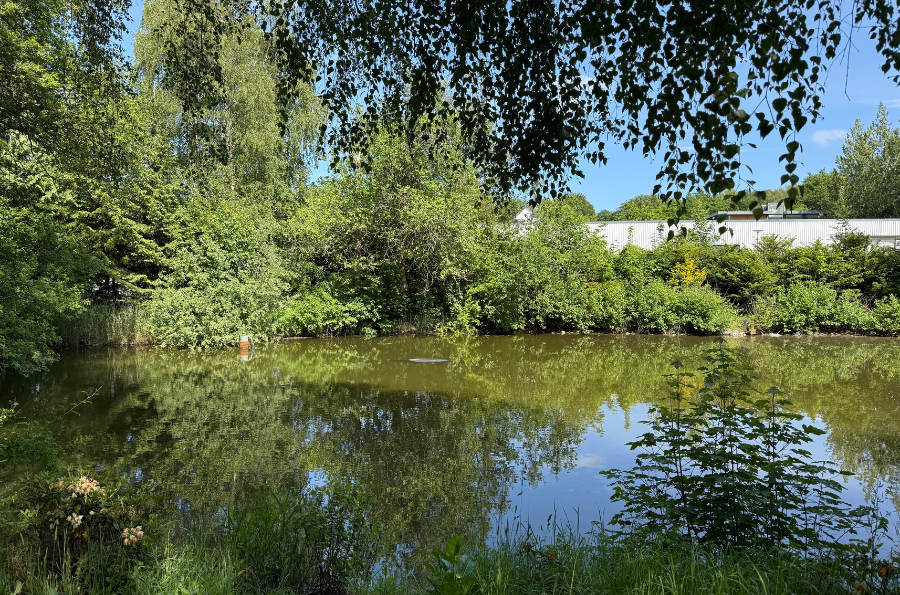
Pouch Lake in DTU Science Park is not only a tranquil spot for a short break, it also plays an important role in advanced research and technological development.
Besides supporting local birdlife, the lake is also used by DHI, a company based in DTU Science Park and one of Denmark’s seven approved GTS institutes (Approved Technological Service Institutes). These institutes work to promote Danish innovation through specialized testing and applied research.
In fact, four of these institutes have facilities in DTU Science Park, clear evidence of the area’s role as a national hub for knowledge-based innovation.
DHI specialises in water and environmental technology. In adjacent buildings, they conduct tests using water from this lake, such as wave simulations. The test water is stored in a sealed pouch submerged below the surface. Once testing is complete, the water is returned to the pouch. This setup makes it possible to simulate real-world conditions without disturbing the lake’s ecosystem.
The Red Scots Pines
The forest as laboratory
Research is a natural part of everyday life at DTU Science Park and it doesn’t only happen within the walls of laboratories. Through a close collaboration with the Arboretum in Hørsholm, new knowledge is also cultivated in the landscape around us.
The arboretum serves as a living library of trees and shrubs from around the world, contributing to research, conservation, and the promotion of biodiversity. Its partnership with DTU Science Park helps shape the green and diverse environment that characterises the area today.
A striking example of this interplay between nature and science is the red Scots pines. Normally, this species only develops its distinctive reddish colour on the upper part of the trunk, but here, the goal was to create a pine that shows red colouration all the way from base to tip. This was achieved by grafting the red top shoot from one pine tree directly onto the base of another, causing the entire trunk to appear red even from a young age.
It’s a small but notable experiment and a reflection of the kind of knowledge and curiosity that are allowed to flourish when nature and research grow side by side.


The Starling Collective
The ideal setting for a social bird
One of the oldest trees in DTU Science Park, a chestnut,has been given a special role: to attract starlings and serve as their home.
The tree has been carefully pruned and relieved of its heaviest branches to make room for a large number of birdhouses.
Starlings are in decline in Denmark, and with these birdhouses, we aim to give nature a helping hand, hoping that starlings will once again breed here.
Starlings thrive in colonies like this one, where they find shelter, other birds, and abundant food in the surrounding open fields.
By establishing this birdhouse colony, we hope to support the starling population and other wild birdlife.

The Swifts’ Rooftop
New homes for a threatened aerial acrobat
The swift is a remarkable bird that spends almost its entire life in the air, it eats, sleeps, and even mates while flying. However, as cracks and cavities in older buildings disappear, it has become increasingly difficult for swifts to find suitable nesting sites. The species is in decline in Denmark and is now classified as threatened.
To support the population, DTU Science Park has installed specially designed swift boxes to serve as safe, long-term nesting sites. Swifts form lifelong pairs and typically return to the same nest year after year. To make the boxes more attractive, feathers have been placed inside to create a “used” appearance, making them more inviting for curious swifts.
In addition, a sound installation plays artificial calls during spring and summer, mimicking the sounds of an active colony. This increases the chances that swifts will discover and choose these boxes as their new homes.
By providing a safe and familiar place to settle, we hope to welcome more swift pairs and we create the space for nature’s own gliders, right alongside knowledge and technology.

The Urban Tree Arboretum
Knowledge with roots in real life
The Urban Tree Arboretum is a living collection of trees that are either in use today or have the potential to be used in urban environments. It was established in 2001 to support research, education, and informed decision-making about tree species for cities and public spaces.
The arboretum includes a wide variety of species and cultivars, with multiple specimens of each, allowing for comparisons of growth, resilience, and long-term responses to different pruning methods.
Collaboration with the arboretum gives DTU Science Park and its stakeholders a unique opportunity to observe how trees develop in practice, not just in theory. Here, planners, students, and professionals can gain concrete knowledge and inspiration about how trees actually behave over time.
Insights from the arboretum help lay the groundwork for better decisions about urban greenery and contribute to an environment where people, ideas, and sustainable solutions can all grow.


The Woodpecker Trees
The Woodpecker’s Trunk Café
At DTU Science Park, we strive to use nature’s resources responsibly and to support biodiversity wherever possible.
When trees must be felled, some trunks are repurposed as “woodpecker trees.” These upright, branchless trunks serve as important habitats for insects, fungi and not least, woodpeckers.
The woodpecker is a fascinating bird with an impressive ability to find food: using its strong beak, it chisels into bark and wood, and with its long, sticky tongue, it extracts insects and larvae from even the narrowest crevices.
By leaving the trunks without branches, we ensure both stability and function, creating small, self-sustaining ecosystems in an area where nature and technology are encouraged to develop side by side.

